
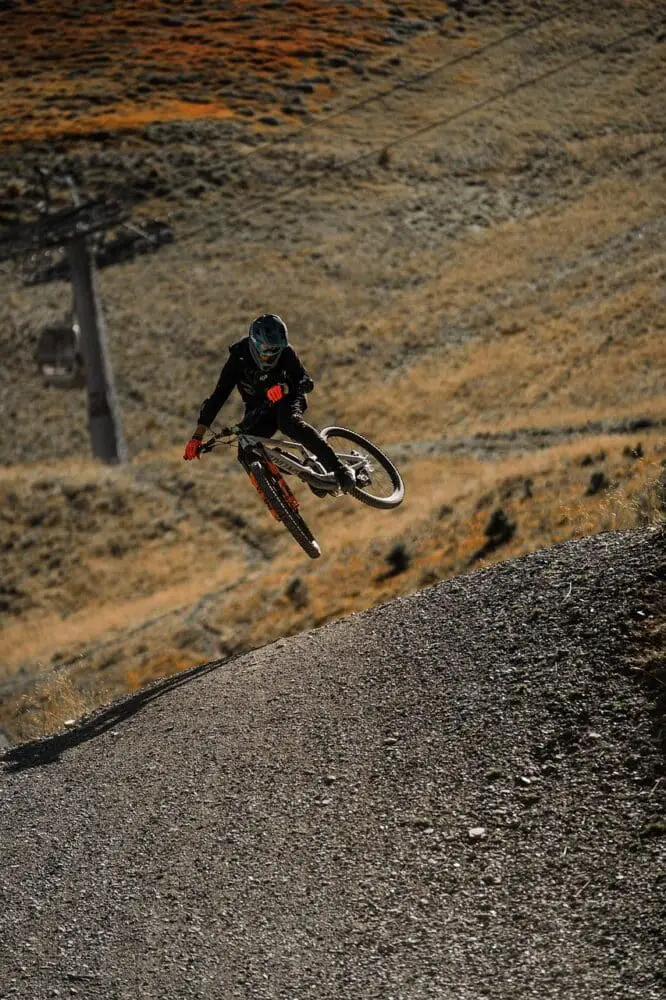
Why Learn How to Whip a Mountain Bike?
Mountain biking is not just about riding a bike, but it’s about mastering the art of control and flow on diverse terrains. Learning how to whip a mountain bike can enhance your riding skills and allow you to ride with style and precision effortlessly. By whipping your mountain bike, it enables you to navigate through tricky corners or jumps efficiently without losing control or speed.
Here’s a six-step guide on How to Whip a Mountain Bike:
- Start by finding an open area where you can practice whipping.
- As you approach the jump, lean back and pull up on your handlebars.
- Once in midair, shift your weight towards the back wheel while pushing down on the opposite foot creating a horizontal rotation of your bike in mid-flight.
- Aim to land are rear tire first while keeping your body centered over the bike.
- To make the whip more prominent, add some ‘flare’ by extending arms and legs outward during the rotation.
- Practice makes perfect. Keep practicing until you feel comfortable and confident enough to perform a whip in different terrains.
In addition to enhancing your riding skills, learning how to whip also adds an element of style that can impress others when performing it correctly. When executing whips, always consider safety first. Ensure there are no obstacles around, wear protective gear like helmets, gloves, elbow pads, knee pads and be aware of other riders using the same trail.
Lastly, a true story about gaining confidence from Whipping: A beginner mountain biker – Rosemary was hesitant about jumping or cornering because she feared losing control of her bike. However after some time practicing whips in an open field helped her understand her limits as well as learn new techniques while gaining confidence in herself as a rider.
Learning to whip a mountain bike is like learning to dance with a chainsaw – it’s dangerous, but oh so satisfying when you get it right.
Learning the Basics
To learn the basics of whipping a mountain bike perfectly, you will have to master body positioning and preparing for the jump. By acing these two sub-sections in mind, you can easily perform a proper whip and land smoothly.
Body Positioning
Maintaining correct body alignment is critical in any physical activity. To ensure proper posture, align your shoulders with your hips, keeping your back straight, and maintain a neutral spine position. Avoid rounding or arching your back while doing any exercise or activity that may put extra strain on the lower back. A good foundation for correct body positioning includes maintaining balance between muscle groups and proper breathing techniques to help build consistent endurance levels.
To avoid potential injuries caused by poor body posture, it’s essential to wear comfortable clothing that allows for full range of movement even when engaging in high-intensity activities. Slightly bend your knees during exercises to support the spine and ease tension in the lower back muscles while keeping a line from ears through hips during land-based exercises.
Proper equipment can also help maintain correct body posture. For example, athletic shoes with ample support prevent the ankles from becoming fatigued and improve overall body function during workouts.
Keeping a balanced diet is yet another way to achieve prime physical fitness and improve overall muscular endurance and strength. This goes hand-in-hand with adopting healthy habits such as minimizing stressors like alcohol consumption and obtaining adequate rest, all of which contribute positively to better physical health.
By following these basic tips regarding positioning, workout attire selections, equipment choices, and healthy living practices, anyone — regardless of experience or ability — can safely undertake any form of exercise to achieve optimal results.
Get ready to take the leap and hope the parachute was packed correctly.
Preparing for the Jump
Understanding the Leap: Preparing for Liftoff
To begin your journey of learning, it is crucial to prepare for the jump. Knowing how to prepare can mean the difference between success and failure in your studies or career. Here are six basic steps to take before diving into your learning process.
- Identify Your Goals – Determine what you want to achieve from learning.
- Analyze Your Learning Style – Discover the most effective way that you learn, whether visual, auditory or kinesthetic.
- Evaluate Resources – Assess available resources and select appropriate tools such as textbooks, apps or mentors.
- Create a Schedule – Develop a structure that is both consistent and flexible based on your available time and needs.
- Set Yourself up for Success – Ensure that your workspace has efficient lighting, adequate space and minimal distractions.
- Establish Accountability – Share your goals with someone who can keep you accountable.
When setting out on this endeavor, it’s also beneficial to keep in mind that everyone learns differently and at their own pace. By being proactive in preparing for the jump, you’re on track for a more successful experience.
In addition to these steps, consider taking small manageable steps forward every day towards achieving those goals will be impactful long-term. Finally, always remain open-minded and remember that mistakes are opportunities to grow and learn!
Ready to soar? Buckle up, sit tight, and hope for the best – because we’re about to take flight.
Taking Flight
To take flight on your mountain bike with confidence, you need to master the technique of lifting the bike and shifting your weight. This is where the section “Taking Flight” with sub-sections “Lifting the Bike, Shifting Weight” comes in as a solution. Let’s break down each of these sub-sections to understand how to whip your bike in style.
Lifting the Bike
When it comes to Elevating the Bicycle, it can be challenging as it is a heavy and awkward object to lift. Fear not as we have got you covered with three easy steps.
- Before lifting, ensure the bicycle is in a stable upright position.
- Get a firm grip on the handlebars and saddle
- Lift with your legs, keeping your back straight, and raise the bike to your desired height.
To avoid injury, ensure you have enough strength to lift the bicycle. Additionally, wear gloves for extra grip.
It is worth noting that there are various techniques for lifting different types of bicycles. According to Tech Tips from Park Tool, when lifting a mountain bike or one with a sloping top tube design without a seat post quick release, flip it upside down and rest it on its saddle and handlebar.
It is interesting to know that lifting the bicycle might seem like an incidental aspect of cycling, but improper handling can cause hand fractures or wrist strain. Shifting weight is the law of nature, unless you’re a flight attendant trying to balance a plane full of passengers.
Shifting Weight
As the plane takes off, a delicate balance is maintained by shifting the weight of the aircraft. Pilots and engineers work together to ensure that this process is done smoothly and without any major disruptions. By redistributing the weight, different sections of the plane can be balanced correctly, allowing for safe and smooth flight.
The need for shifting weight during takeoff is crucial as every inch matters when it comes to flying at high altitudes. The difference between a successful takeoff and a failed one often depends on how well the weight is distributed. It’s not just about adding or removing cargo; factors such as passengers’ placement, fuel levels and distribution also impact this process.
Aircraft manufacturers invest significant resources into designing planes that handle shifts in weight seamlessly. For instance, designers ensure that fuel tanks are constructed closer to each other to improve stability during lateral shifts. Moreover, pilots also have sophisticated tools that help them monitor critical elements such as altitude, velocity and acceleration.
Pro Tip: Ensuring correct weight distribution is crucial while taking off an aircraft. Pilots use advanced technology to reduce manual errors in this process.
Don’t think of it as landing, think of it as a dramatic entrance.
Nailing the Landing
To perfect your landing when mountain biking, it’s crucial to absorb impact and keep balance. In this section, “Nailing the Landing,” we’ll explore these sub-sections as solutions to help you nail the landing. First, we’ll delve into the importance of absorbing impact, followed by how to maintain balance to ensure you remain in control of your bike.
Absorbing Impact
Optimizing the Technique for a Safe Landing
Successfully carrying out a perfectly executed jump requires skills in several areas, ranging from strength training to precise timing. However, one of the most critical factors involved is safely landing the jump, which necessitates absorbing impact forces effectively. It involves the right combination of technique and equipment for handling force distribution.
To accomplish this task safely and efficiently, jumpers must learn how to use their legs and knees as shock absorbers. The strategy emphasizes using your leg muscles and joints to cushion your downward momentum while reducing injury risk. When landing, your knees will bend while you maintain your center of gravity to ensure that force is distributed evenly.
Furthermore, reducing impact forces starts by practicing proper landing technique. Using equipment like mats or foam pads can also assist in dampening forces during training sessions. Jumpers should also undertake conditioning exercises that improve muscle mass, balance, and range of motion; this enables smoother landings and lower injury risks.
Ultimately, there are numerous ways to absorb impact force while landing after performing a jump. A good implementation might be using jump-specific shoes which provide extra support for jumping or practicing on softer surfaces a few times if possible before attempting a hard surface. The primary goal is to correctly distribute forces throughout the body rather than concentrating it all on specific areas such as bones or joints which would result in serious long-term injuries.
“If you want to keep your balance, don’t look down…unless you want to see the impending doom of a botched landing.”
Keeping Balance
Maintaining Equilibrium
To execute a successful landing, maintaining equilibrium during the entire process is crucial. Absorb the kinetic energy by slightly bending your knees and keep your feet hip-width apart to distribute the weight evenly. Perfect timing and balance are necessary as it prevents you from falling off or injuring yourself.
Keeping balance is all about your landing technique. Pay attention to where you are placing your feet and maintain proper form while landing. The key here is to control your body weight and use the momentum to guide your movements towards a stable landing. Make sure that both of your feet touch down simultaneously.
It’s important not to forget about the minor nuances as well when it comes to keeping balance during a landing. Even slight distractions can potentially throw you off, so always remain focused on what you are doing, whether it be weather conditions or other possible interruptions.
Don’t miss out on perfecting this fundamental skill! Start practicing with a softer surface before moving onto harder terrains. Consistent practice will eventually lead toward nailing that perfect landing with ease!
Get ready to whip out some sweet tricks because we’re progressing to advanced whips, and trust me, it’s not for the faint of heart.
Progressing to Advanced Whips
To progress to advanced whips with adding style and increasing difficulty, this section explains how to whip a mountain bike. Adding style to whips can take a whip from a basic trick to a jaw-dropping spectacle. Increasing difficulty is the key to pushing your limits and providing the biggest adrenaline rush. Let’s explore these sub-sections further to achieve top whip skills.
Adding Style
This section aims to provide insights into elevating the aesthetics of whipping moves. By incorporating creative and aesthetic elements into your whipping practice, it can take your skills to the next level. Understanding the importance of adding style can make even a basic move look visually appealing and unique.
The effective implementation of adding style to your whipping skills can be achieved by adding spins, turns, twirls and other variations to your movements. Furthermore, you can try experimenting with footwork and body positioning which will enhance the overall output.
In addition to this, it’s important to note that the type of whip being used will also play a significant role in determining how aesthetically pleasing the movements are. Different types of whips will allow for different forms of creativity.
One relevant true story is about a whip enthusiast who had been practicing their basic whips for months without much interest or passion. However, after attending a workshop that focused on spicing up their moves through various styles and techniques, they became extremely invested in their practice, leading to impressive progress in their skills within weeks.
Ditch the beginner whips, it’s time to up your game and whip out the advanced moves – just don’t whip yourself into a frenzy.
Increasing Difficulty
As the skill level of whipcracking increases, the difficulty of whips must also progress. This requires advanced techniques and precision when handling the whip to avoid injury. In its advancement, one must learn to control the whip’s power and speed to perform elaborate patterns smoothly without defying safety measures.
To achieve the desired advanced level, incorporating intricate arm movements and footwork into whip routines is fundamental. The aim is not only to narrow down on achieving flashy moves but also to turn them into a seamless performance that complements one’s timing and coordination.
When progressing to advanced whips, it’s important to note that safety should always be at the forefront during practice sessions. Expert guidance from experienced individuals or certified trainers will aid in transitioning flawlessly. Failure to follow basic precautions can lead to significant consequences.
A study by The Royal Society Publishing indicates that most whip-accidents occur infrequently; however, their severity leads to significant injuries when they do occur.
Practice makes perfect, but progression means upgrading to a safe word that’s three syllables or less.
Practice and Progression
Mastery of Mountain Biking Techniques through Consistent Improvement
Confidence in mountain biking can be enhanced through consistent improvement in skills. Building a strong foundation by practicing basic techniques and gradually advancing to more challenging ones is crucial. Starting with small obstacles and then progressing to bigger ones, while focusing on proper technique, can lead to success.
Progression is key when mastering mountain biking skills. After becoming familiar with various techniques, it is essential to challenge oneself by taking on more complicated trails, obstacles, or terrain. Embracing trial and error can lead to progress and a deeper understanding of how to adapt technique as circumstances change.
It’s important not just to learn the mechanics but also understand the theory behind different moves and tips for staying safe on the mountain bike trail. Knowing the components of a good jump or drop requires an open mind, patience, attention to detail and listening to experts who have mastered these techniques.
In 2009 BMX legend Dave Mirra committed himself wholly into getting better on “whips” (a trick where riders kick out their back wheel while leaping off ramps). He drove himself each day over several months by perfecting his style on trails ranging in difficulty before unveiling his tricks at X Games – where he won Gold in Freestyle BMX Big Air Competition.